In short
- A light colour reflects more light and helps kitchens with little light; a dark one calls for reinforced task lighting.
- The finish (matt, satin, gloss) influences reflections and how visible fingerprints are.
- White and black do not behave the same way in every material: lacquer, thermo-laminate, melamine and paint each behave differently.
- Worktop, wall covering and floor have to work with the colour of the cabinets.
- Grey is the middle ground: the shade (light to dark) and the undertone (warm or cool) change the atmosphere and are tested on a sample.
- Test samples in your kitchen, in the morning, afternoon and evening.
How does the kitchen's natural light influence the choice?
Not all kitchens are bright. When the room receives little natural light, light colours help maintain a pleasant level of light, because they reflect more of it.
In a black kitchen, the effect is the opposite: the surfaces absorb light. It is not a defect, it is a design condition. Lack of light is one of the most sensitive points of a black kitchen when it is not compensated for with suitable lighting.
Look at the kitchen at different times of day before deciding. The same colour changes with the orientation of the windows and with artificial light. See what to consider in kitchen lighting.
What changes in a black kitchen?
Most common finishes
A black kitchen is made mainly with paint, lacquer, thermo-laminate or melamine, and less often with metallised fronts. Each finish behaves differently to the touch, to wear and to cleaning. To understand the differences, see lacquered versus thermo-laminated kitchens.
Worktop and wall covering
The worktop can also be black, in stone with discreet veining, or another colour, which is then repeated in the wall covering between the worktop and the wall cabinets. The choice of material should take use and maintenance into account: see kitchen worktops.
Task light
In a black kitchen, the worktop needs reinforced light, so that cooking is comfortable and safe. Plan the lighting from the design stage: general light, light over the worktop and supporting light.
What changes in a white kitchen?
Finishes
The white kitchen uses the same materials and finishes as the black one. The most common composition is flat, without grooves or raised panels.
Neutrality
White is neutral and combines well with other textures and colours. It leaves open the choice of wall covering, worktop, floor, sink and tap.
There are cooler and warmer whites. Compare the undertone of the white with the floor, the walls and the light in the room, using real samples.
Layouts that help the light
The kitchen with a peninsula and the kitchen with an island free up the walls and allow task light to be placed directly over the central worktop, which helps compensate for a less bright room. White works well in these layouts.
What about a grey kitchen?
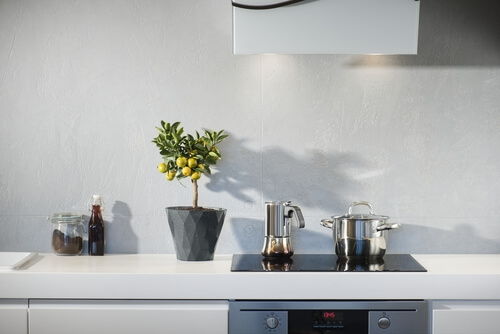
Grey sits between white and black, but it is not a single colour: it ranges from light to graphite and from warm to cool. A light grey comes close to white and reflects more light; a graphite comes close to black and calls for the same reinforced task lighting.
After the shade, look at the undertone. Warmer-based greys recall beige; cooler ones lean towards blue. It is the undertone that defines how the grey works with the floor, the worktop and the light in the room, so compare it on a real sample, by day and at night.
Where to use grey
It can be on the cabinets, the floor, the walls or the covering of the worktop wall, but it rarely works on all of them at once. Choose one dominant element and use the others to create contrast. For the worktop wall, see kitchen tiles.
Which combinations work?
- Mid grey, with a vintage character. With a marble worktop and handles in warm-toned metal, such as copper. Marble is sensitive to stains and acids: see kitchen worktops.
- Classic grey. Light grey cabinets over a cement-look porcelain stoneware floor, durable and easy to clean, with a marble worktop for contrast.
- Industrial, in graphite. Graphite joinery with light wood; a white worktop and tiles balance the whole.
- Modern, in silver tones. Acrylic solid surface worktop, "metro" format tiles in a darker grey than the cabinets and cabinets without visible handles.
- Modern, in stainless-steel tones. Metallic grey with a gloss finish, a white quartz worktop and chrome accessories.
How to avoid a grey that is too cold
Cool greys with stainless steel and pure white create a technical atmosphere. Wood, warmer whites and warm-toned light make it more welcoming.
Matt or gloss?
Gloss defines reflections and how visible marks are.
- High gloss. It reflects more light and gives a sophisticated look. It shows fingerprints and marks easily.
- Matt. For kitchens in daily use and with frequent cooking, spacelovers tends to suggest matt, which shows fingerprints less.
- Satin (semi-gloss). An intermediate solution.
The choice of gloss level applies to white, black and grey, and should be seen on a sample, in the light of your home.
How do you decide?
Answer these questions.
- Is the kitchen bright? If not, a light colour makes things easier; if it is black, reinforce the lighting.
- Do you cook every day? Prefer matt finishes and surfaces that are easy to clean.
- Which materials will it be combined with? Worktop, wall covering, floor and appliances influence the colour of the cabinets.
- Does the kitchen open onto the living room? In an open-plan space, the colour should work with the living area. See open-plan kitchen and living room.
It is also possible to combine: light cabinets with dark areas, or the other way round. Wood helps balance cooler settings.
In a spacelovers project, colour and finishes are decided together with the light, the joinery and the coverings; the Client hires the kitchen supplier and the building contractor directly. See the kitchen renovation page.
Frequently asked questions
Do white and black hide grease and dust?
Neither colour hides everything. White shows more stains and dark crumbs; black shows dust and fingerprints more easily. A matt finish helps in both cases. Good extraction reduces grease in the air: see the ventilation and extraction design.
Can I mix white, black and grey?
Yes. For example, light cabinets with a dark worktop or wall covering, or grey only on the floor or the island, with the rest neutral. Set one dominant colour and limit the others.
Does grey go with wood?
Yes. Light wood breaks the coldness of grey and works well with graphite.
How do I test the colour before ordering?
Ask for samples of the exact finish and look at them in the kitchen, in natural and artificial light. Compare them with the floor, the worktop and the wall.