In short
- Thermolaminate tends to be more affordable, wear-resistant and easy to clean, but the edge banding is the point that is sensitive to moisture.
- Lacquer offers a continuous, jointless finish, with great freedom of colour and design, but it scratches more easily and is harder to repair.
- Around the sink and the dishwasher, the quality of the finishing matters more than the material.
- Replacing parts in the future is a criterion to weigh from the start.
- The most important thing is to ask the supplier how the product is made, and to ask for samples.
What is a thermolaminate kitchen?
It is a kitchen whose fronts are panels with a laminate surface, with the edges finished in edge banding of the same or a different colour. The laminate gives resistance to wear, impact and stains (near sources of intense heat, confirm the limits with the supplier), and the surface is non-porous, which makes cleaning easier.
Because the material is not continuous, the edge banding is a joint. If it is poorly applied, it leaves the edge exposed to moisture. Ask the supplier to explain how the edge banding is bonded and how the finishing is done. In practice, the panel is usually chipboard or MDF faced with melamine film or laminate.
What is a lacquered kitchen?
It is a kitchen whose fronts receive a coat of paint (lacquer), applied to the faces, edges and cut-outs, which gives it uniformity. It can be matt, satin, gloss or textured, depending on the quality of the paints and of the process. The finish is continuous, with no joints.
The colour can be chosen from reference colour charts and should be coordinated with the tiles where they meet. See kitchen tiles.
What are the advantages and disadvantages of each?
| Thermolaminate | Lacquer | |
|---|---|---|
| Price | Tends to be more affordable | Tends to be more expensive |
| Surface | Resistant to scratches and impact | Scratches more easily |
| Cleaning | Very easy | Good, but less easy |
| Moisture | Edge banding is the sensitive point | Faces well protected; edges and drillings depend on the substrate and the process |
| Colour and design | Wide variety, but limited to the catalogue | Any colour and a range of cut-outs |
| Replacement | Colour or texture may be discontinued | New lacquer rarely matches the old |
| Appearance | Visible edge banding, may form a dark line | Continuous, jointless |
There is no option that is better in absolute terms. There is the one that suits how you use it.
When should you choose thermolaminate?
- When the kitchen is in intensive use and you want a robust surface.
- When you are looking for a uniform factory finish, with a wood, stone or metal effect.
- When standard colours (whites, greys and neutral tones) are enough for the design.
- When you want edges in a different colour from the door faces, as a detail.
Limits: edge banding sensitive to water, more limited handles and opening systems, and uncertain replacement.
When should you choose lacquer?
- When you want a specific colour or a jointless finish.
- When the design calls for cut-outs, recesses or special shapes, such as those made in MDF.
- When you value the soft feel of a matt finish.
Limits: it scratches more easily, repairs require care, and a new part may not match the colour of the old one, because colour changes over time and with sun exposure. A gloss finish shows irregularities more.
Where does the choice matter most?
Near the sink and the dishwasher. Moisture attacks the edges. Ask for well-bonded edge banding, careful finishing and protection on the underside.
Hob area. Check the finish's resistance to heat and the distance from the hob. Ventilation and extraction help: see ventilation, air-conditioning and fume extraction design.
Handles and opening systems. Some handleless systems are not suitable for thermolaminate. The kitchen cabinet hardware and the type of front should be decided together.
How should each type of front be maintained?
- Thermolaminate: a damp cloth, with little water, and a multi-purpose detergent without harsh components. Avoid waxes, which leave the surface greasy.
- Lacquer: careful cleaning, without abrasive scourers. Avoid scratches and protect from direct sunlight.
Always check the manufacturer's instructions.
How do you combine fronts, worktop and the rest of the design?
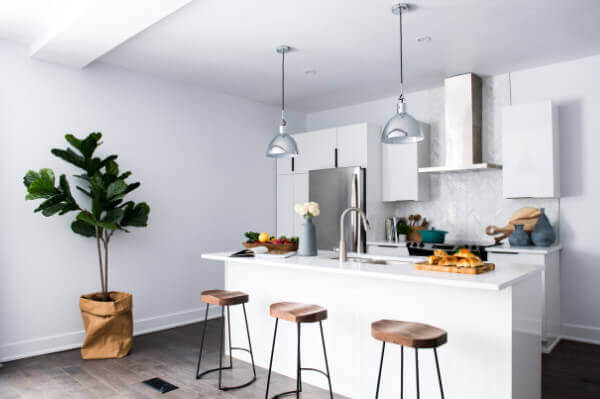
The fronts are part of a system. The worktop and the wall finish have to work with them. See kitchen worktops. In designs with an island, the island can have a different finish from the rest: see the kitchen with an island.
To decide between standard and made-to-measure, see modular versus made-to-measure kitchens. For the overall picture, see the kitchen renovation page and our renovations.
Frequently asked questions
Can I mix lacquered and thermolaminate fronts in the same kitchen?
You can, for example with the island or the tall units in one finish and the rest in another. The design should ensure that the colours and sheens match.
How can I tell whether the edge banding is well made?
Ask for a sample and look at the edge: the glue should be even, with no gaps and no visible dark line. Ask the supplier how it is applied.
What if I need to replace a door in a few years' time?
Ask the supplier whether the colour or texture will remain available and how they would reproduce the colour of a lacquered front. Keep the design references.