In short
- ITED is the telecommunications infrastructure inside the building and its connection to the public networks.
- The regime is set out in Decree-Law No. 123/2009, as currently in force, and in the ITED Manual published by the National Communications Authority (Autoridade Nacional de Comunicações, ANACOM).
- As a rule, the project is mandatory in the construction and reconstruction of buildings, including houses.
- In existing buildings, a simplified technical project for a single technology may be enough.
- There are two statements of responsibility (termos de responsabilidade): the designer's, for the project, and the ITED installer's, for the installation.
- It must be coordinated with the architecture and with the electrical project.
What is the ITED project?
It is the project for a building's telecommunications infrastructure and its connections to the public networks. It defines the location and sizing of the conduit networks, cabling, cabinets and outlets, so that any operator can provide service in the building.
The regime is set out in Decree-Law No. 123/2009 of 21 May, as currently in force, and its technical reference is the ITED Manual published by ANACOM, in the edition in force. The infrastructure must give operators open, transparent and non-discriminatory access.
What about ITUR?
ITUR (Telecommunications Infrastructure in Urban Developments, Infraestruturas de Telecomunicações em Urbanizações) applies to plot subdivisions (loteamentos), urban developments and groups of buildings. It ensures that the external networks are ready to connect to each building's infrastructure and has its own project, designer and installer.
When is an ITED project required?
In the construction or reconstruction of a building, the ITED regime applies on a mandatory basis, with a technical project, save for the exceptions provided for in Decree-Law No. 123/2009. Ministerial Order (Portaria) No. 320/2026/1 includes the "telecommunications infrastructure project" in the list of specialty projects for the building permit (licença) and the prior communication (comunicação prévia) of building works.
In existing buildings without ITED, there is a lighter solution: the simplified technical project, limited to a single technology (copper pairs, coaxial cable or optical fibre). It is used, for example, to install a fibre-optic riser in an old building. In a renovation of an existing apartment or house, what needs to be submitted depends on the intervention and is confirmed at the start of the project.
Who can prepare the ITED project?
An ITED designer qualified under Decree-Law No. 123/2009: an engineer or technical engineer registered with the relevant professional body and holding the qualification required for this type of project.
The designer issues the statement of responsibility for the project. The installation is carried out by a qualified ITED installer, who issues, at the end, the statement of responsibility for the installation. Both statements are recorded in ANACOM's public database, where they can be consulted.
What does the project contain?
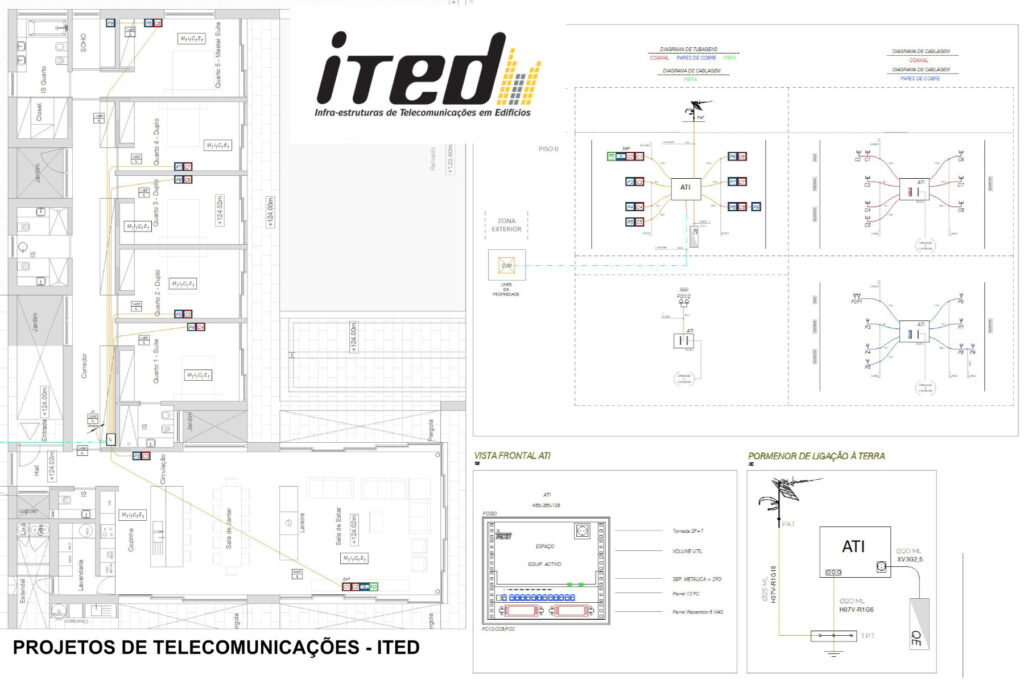
The content of the project, with written documents and drawings, is defined by the ITED Manual and varies with the type of building. In general, it includes:
- the characterisation of the building, its use and the number of units (frações);
- the definition of the technologies to be installed and the network topology;
- the diagrams and layout of the conduit and cabling networks;
- the sizing of the cables and the signal level calculations;
- the connection to the operators' infrastructure and to the earthing network;
- the bill of quantities and the material specifications.
Installations may use copper pair cables, coaxial cables and optical fibre.
How does it develop? The stages
- Brief. Survey of needs, taking into account the type of building, the intended use and the number of units.
- Project and statement of responsibility. The designer completes the project and issues the statement of responsibility. The project forms part of the documents submitted to the municipal council (Câmara Municipal) together with the other specialities.
- Installation. The installation is carried out by a qualified ITED installer, in accordance with the project, with compliant materials.
- Installation statement. At the end of the installation, the installer issues the statement of responsibility for the installation, which certifies that the installation complies with the project and with the applicable technical rules.
How does it fit with the architecture and the permit procedure?
ITED depends on the design of the building: where the telecommunications cabinets, technical galleries and risers go, the routes through the common areas and the outlets in each room. It therefore needs coordination with the architecture project and with the electrical project, because of the earthing and the common routes.
Under Decree-Law No. 555/99, as currently in force, specialty projects are submitted to the municipal council with the building permit (licenciamento) application or after the architecture project has been approved; in the prior communication, they form part of the application itself. The general framework is set out in engineering specialty projects. In apartment renovations, it is worth knowing from the outset what needs to be submitted.
How do we handle this speciality?
spacelovers is an architecture studio in Lisbon. It carries out the design, handles the permit procedure and provides technical assistance during construction. In our architecture projects, the position of the cabinets, risers and outlets is decided together with the architecture, and the ITED project is prepared by a qualified designer and coordinated with the other specialities. During construction, we provide technical assistance on the Client's behalf. Decisions and contracts belong to the Client.
How much does an ITED project cost?
It depends on the size and complexity of the building and on what the Client wants. We prepare a proposal for each case: Request a proposal.
Frequently asked questions
Does a house need an ITED project?
In construction or reconstruction, as a rule yes: the ITED regime applies to buildings, including houses, and the decree-law provides for exceptions that are confirmed case by case. For works on an existing house, it depends on the intervention.
What is a simplified ITED project?
It is a technical project for a single technology, used in existing buildings, for example to install optical fibre in a building without ITED. It also has a designer's statement of responsibility, and the installation is carried out by a qualified ITED installer.
Where can you check whether a building has ITED?
In ANACOM's public database, where the ITED and ITUR statements of responsibility for the project and for the installation are recorded.
This content is for information only and does not constitute legal advice. For your specific situation, legal advice should be provided by a qualified professional in the field.
Photo: spacelovers.