In short
- The rustic kitchen combines natural materials, earthy tones and handcrafted details.
- Wood, stone and hand-painted tiles call for maintenance decisions from the outset.
- Open shelves give character, but require regular tidying and cleaning, especially near the hob.
- Organising by zones (preparing, cooking, washing, storing) makes everyday life easier.
- The working dimensions are those of any kitchen: a worktop 85 to 95 cm high and 60 to 65 cm deep, and 1.2 m of clear space between parallel worktops.
- Extraction and task lighting are resolved in the design, not in the decoration.
What defines a rustic kitchen?
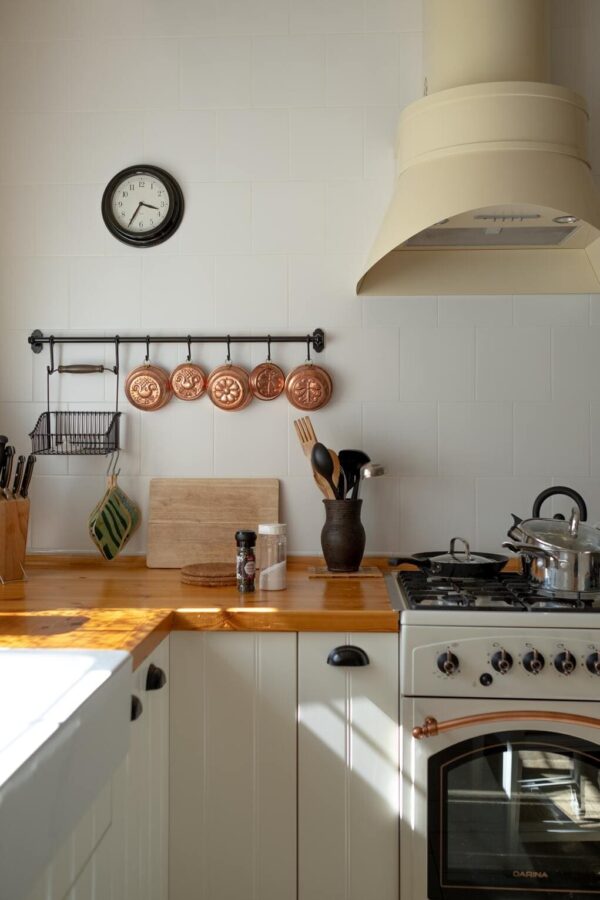
The rustic kitchen is based on natural materials (solid wood, stone, ceramics, metal), on earthy tones or on weathered whites and blues, and on details that show the hand of whoever made them. Wrought-iron handles, hand-painted tiles and iron or glass light fittings are examples.
It is a more traditional language than that of a contemporary kitchen, with more texture and fewer smooth surfaces. That is why it suits old houses well, but it can work in any home if the design supports it. For existing kitchens that you want to restore, see old kitchens.
Which materials to choose and what care do they need?
The rustic character comes from the materials, and each material has its own demands:
- Solid wood. It warms the room, but next to the sink and the hob it needs protection and maintenance. Think about where you use it.
- Natural stone. It gives visual weight and durability; some stones absorb liquids and grease and may require treatment. The supplier indicates what is appropriate.
- Hand-painted tiles. They work well as a wall covering above the worktop. See which tiles to choose for the kitchen.
- Flooring. Aged wooden boards, ceramic tiles with a traditional pattern or natural stone: choose one that withstands water, heat and heavy use.
The useful question is not "which material looks good?", but "which material can withstand what we do here every day?". For the top, see kitchen worktops.
How do you organise storage in a rustic kitchen?
Storage decides whether the rustic kitchen works. The solutions typical of the style are well known, and each has pros and cons:
- Open shelves. They display earthenware and pans. They gather dust and grease if they are near the hob; keep on them what you use frequently.
- Hooks and rails on the wall. They keep utensils to hand and free up drawers. They work best away from the frying zone.
- Glass doors on some cabinets. They display crockery and glasses without leaving them exposed to dust.
- Baskets and boxes. They group similar items (cloths, dry goods) and hide the variety.
A traditional option is the pantry, an enclosed storage space. See the pros and cons in pantry in the kitchen.
How do you organise by zones?
Group together what is used together:
- Preparation, with a clear worktop and utensils and ingredients within easy reach.
- Cooking, with pots and pans near the hob.
- Washing, next to the sink and the dishwasher.
- Storage, with pantry, fridge and crockery cabinets.
The working worktop is between 85 and 95 cm high, adjusted to whoever cooks, and between 60 and 65 cm deep. A central wooden island or table can add worktop and storage and serve as a meeting point, provided 1.2 m of clear space is left between it and the parallel worktop. If this applies, see the kitchen with an island page. If the kitchen has a dining area, plan it from the start so as not to restrict circulation.
What about extraction and light?
These are the two areas in which the rustic style depends most on the technical design.
- Extraction. Wood, fabrics and open shelves suffer more from grease and steam. Hob extraction is designed with an outlet to the outside, and the position of the hob must allow it. Keep open shelves and wooden elements away from the hob, respecting the distances specified by the appliance manufacturer.
- Light. Traditional-style light fittings (iron lamps, lanterns, wall lights) create atmosphere, but rarely light the worktops on their own. Task lighting is provided over the worktops, even if discreet. See kitchen lighting.
Rustic, vintage or old: what is the difference?
The rustic kitchen relies on natural materials and tradition. The vintage kitchen embraces period references, bright colours and patterns. Old kitchens are those that already exist in the house and can be kept, restored or replaced; the vintage style and old kitchens are covered in the same article, old kitchens. You can combine languages, but it is best to decide which one leads, so that the kitchen does not end up as a mix without criteria.
What is spacelovers' role in a rustic kitchen project?
spacelovers is an architecture studio: it designs the kitchen (layout, storage, materials, extraction, lighting and technical connections), handles the permit process (licenciamento) when required and provides technical assistance during construction. Decisions and contracts belong to the Client, who hires the building contractor and the joiner directly; spacelovers is not a building contractor and does not sell kitchens. See the kitchen renovation page.
Frequently asked questions
Does a rustic kitchen work in an apartment?
Yes, in moderation. In smaller areas, a few elements (a wall covering, the handles, a wooden top) are enough to give character without overloading the space.
Is it possible to combine a rustic kitchen with modern appliances?
It is common. The appliances can be built-in, hidden behind wooden doors, or freestanding. The choice affects recesses, connections and ventilation, so it is settled in the design, before the joinery is drawn.
Do open shelves mean more work?
They do, especially near the hob. They work well for frequently used items that are easy to clean.
Photo: Ron Iach (Pexels).